Tuesday, January 27, 2015

Warm Up Fence Configuration to Maximize Limited Space

At the IEA show I stewarded on Sunday, Jennifer Mastronardi, show host and coach of the Middle Georgia IEA Team, set up the two warm up fences in a configuration I had never seen before.

We had rain and below-freezing temperatures the day and night before the horse show, so we had to move the show, including the warm up area, into the covered arena at the Georgia International Horse Park in Conyers, Georgia.

Space was tight, and we needed to make use of every possible inch of usable arena space. Coach Jennifer's configuration, shown below, fit the bill.


Here is how you ride this warm up pattern:

  • Enter the warm up area from the left hand side of the diagram and track left toward Fence 1. You have the option of going directly to Fence 1 or making a circle in the bottom half of the warm up area.  
  • After Fence 1, continue on the left lead along the rail, then turn left across the diagonal and execute either a simple or flying change (determined by the needs of the horse), and proceed on the right lead up Fence 2.
  • After Fence 2, continue on the right lead along the rail, then turn right across the diagonal executing another simple or flying lead change and ending up at the main show ring in gate.

A few notes about this configuration:
The two warm up fences are placed right up on the rail, which allows the maximum amount of usable space, but also allows no space along the rail between the warm up area and the main show ring for coaches to stand and coach their riders. To fix this issue, during fence classes, the coach of the rider in the show arena stands in the in-gate area along with the show steward. No other individuals are allowed inside the warm up area.

During flat classes, coaches and riders are allowed to stand along the rail that runs between the warm up area and main show ring, but are asked to exit the area once the flat class begins lining up to allow the first rider in the next fence class to begin her warm up.

Using this warm up pattern, we were able to make a large IEA show run continuously all day long with no noticeable delays and finish at a reasonable time.

I love learning new ways to make IEA shows run smoother and more efficiently. Do any of my blog readers have a different warm up configuration you prefer? Please share in the comments.

And a huge thank you to Jennifer Mastronardi and the Middle Georgia IEA team for putting on a well-run show and inviting me to be your steward. :-)

Amanda Garner is an Interscholastic Equestrian Association (IEA), Intercollegiate Horse Show Association (IHSA), and Georgia Hunter Jumper Association (GHJA) steward, schooling show judge, head coach of the University of North Georgia IHSA Equestrian Team, and owner of Epiphany Farm, LLC in Dahlonega, Georgia. She is also a member of the IEA Board of Directors and the author of "A Parent's Guide to the Interscholastic Equestrian Association."

If you enjoyed this blog post, please feel free to like and share on Facebook.
Thanks!  --Amanda

Tuesday, January 20, 2015

CPI 2015--Olympian Michael Page Steals the Show

I spent last weekend in sunny Wellington, Florida stewarding the College Preparatory Invitational Horse Show (CPI) along with IEA National Steward Sue Wentzel.

The CPI is a great opportunity for high school students who are aspiring to ride on a college team. The CPI offers:

  • Five levels of hunt seat flat and fences competition (18 inches to 3 feet) in a horse-draw format similar to IEA and IHSA
  • A college fair attended by representatives of some of the most prestigious equestrian schools in the nation (do the names Hollins, Sweet Briar, or SCAD ring a bell?)
  • College scholarships for high point rider and high scorer on the written horsemanship test
  • The opportunity to experience the Wellington equestrian scene first hand

But hands down, the highlight of the 2015 CPI horse show was our judge, three-time Olympian and Pan American team rider and winner of the 1956 Medal Final, Michael Page.

Before the show started each day, Mr. Page met with the riders to explain his note taking system and asked show management to post all of his judges cards after the show so riders could see the decision making process behind his placings.

Mr. Page also tested every single rider in the flat classes. Tests he used included:

  • Extension and collection at all three gaits, 
  • Work without stirrups, 
  • Circles and half circles,
  • And my favorite ring direction at the conclusion of each class: pat your horses! Those of you who do NOT pat your horse will be eliminated from the ribbons! The judge is watching!

And before you think each flat class lasted three hours and ran the horses to exhaustion, I should tell you he tested the riders as a group all at the same time, including the circles and half circles in a class of 9-10 riders. The classes ran about 10 minutes each, pretty standard length for a flat class. If you thought you could go in there and sit pretty and win, you were in for a big surprise.

At the conclusion of the show Sunday afternoon, Mr. Page addressed the riders and parents at the awards ceremony then spoke one-on-one with judges cards in-hand to every rider who approached him.

Mr. Page is not only a fantastic horseman, he is also a class act.  Oh, and did I mention he's judging the 2015 IEA National Finals in Wellington this April?  ;-)  

Amanda Garner is an Interscholastic Equestrian Association (IEA), Intercollegiate Horse Show Association (IHSA), and Georgia Hunter Jumper Association (GHJA) steward, schooling show judge, head coach of the University of North Georgia IHSA Equestrian Team, and owner of Epiphany Farm, LLC in Dahlonega, Georgia. She is also a member of the IEA Board of Directors and the author of "A Parent's Guide to the Interscholastic Equestrian Association."

If you enjoyed this blog post, please feel free to like and share on Facebook.
Thanks!  --Amanda

CPI judge Olympian Michael Page addresses the riders after the show

Tuesday, January 13, 2015

Ideal Class Order for an Efficient IEA Show

For today's blog, I share my preferred order of classes for IEA shows, which I would argue allows for the most efficient IEA show.

My Preferred Order:
Morning Schooling--2'6" and 2' fences and flat horses

Class 6 Varsity Open Equitation on the Flat
Class 7 Varsity Intermediate Equitation on the Flat
Class 10 Future Intermediate Equitation on the Flat
Class 1 Varsity Open Equitation Over Fences
Class 2 Varsity Intermediate Equitation Over Fences
Class 4 Future Intermediate Equitation Over Fences

Schooling Break--Cross Rail and Beginner Flat Horses

Class 9x Junior Varsity Beginner Equitation on the Flat WT*
Class 12x Future Beginner Equitation on the Flat WT*
Class 9 Junior Varsity Beginner Equitation on the Flat
Class 12 Future Beginner Equitation on the Flat
Class 8 Junior Varsity Novice Equitation on the Flat
Class 11 Future Novice Equitation on the Flat
Class 3 Junior Varsity Novice Equitation Over Fences
Class 5 Future Novice Equitation Over Fences

*optional WT classes

My Reasons Why:
1. This order ensures that no riders are entered in back to back classes, so you don't have anyone rushing to dismount from one horse and mount another in the short amount of time between back to back classes.

2.  This order allows riders to do their flat class first, which gives them a chance to warm up and get moving, especially on those cold horse show mornings.

3.  This order allows two schooling sessions: 2'6" and 2' flat and fences in the morning followed by a second cross rail and beginner flat session half way through the day. This way the upper level horses can get their classes done in the morning and go back to their stall, while the lower level horses get to "sleep in" and do their classes in the afternoon.

4.  This order helps the grid creator to avoid using horses in back to back classes without too much difficultly.

5.  This order places the beginner classes immediately following the cross rail/beginner schooling break, which allows the beginners to ride immediately after the horses have been schooled by professionals or skilled schooling riders, giving the beginners the best chance for a positive experience. Many class orders place the beginners at the very end of the day (when the horses may be tired or cranky) requiring beginner riders to ride through some horse issues that they may not yet have the skills to handle effectively.

The Class Order I See Most Often:
I see many show prizelists with classes listed in this order:

Varsity Open over fences 2'6"
Varsity Open on the flat
Varsity Intermediate over fences 2'
Varsity Intermediate on the flat
Future Intermediate over fences 2'
Future Intermediate on the flat
etc...

With this order, the last rider in the open fence class is also in the open flat class, so the flat class riders have to wait for her to dismount her fence horse and mount her flat horse and get in the ring. This is not ideal time wise, and is also unfortunate for the rider who may feel rushed to get into the ring for the flat.  It seems that almost every time I'm stewarding a show in this format, during the downtime between open fences and open flat, someone asks me why the show isn't moving.

This back to back rider conflict occurs throughout the day in all divisions that are not split into multiple sections. To be fair, if the divisions are split into sections it's possible to ensure that a rider in the B section of fences is not in the A section of flat, which can help alleviate this problem at some bigger shows.

Also, many of the same horses are used in the flat and fences portion of each division (i.e many of the same horses are used for open flat and open fences, etc.), so you are more likely to have horses going in back to back classes.

In Conclusion
There are many possible class orders a show manager can choose for an IEA show.  This is just my personal favorite and one I think works well. If any of my readers have an alternate order you use for your shows, I'd love to hear it.  Please post in the comments.

Regardless which class order you use, I would argue, the key to an efficiently run show is not having any horses or any riders entered in back to back classes.

Good luck and happy showing!

Amanda Garner is an Interscholastic Equestrian Association (IEA), Intercollegiate Horse Show Association (IHSA), and Georgia Hunter Jumper Association (GHJA) steward, schooling show judge, head coach of the University of North Georgia IHSA Equestrian Team, and owner of Epiphany Farm, LLC in Dahlonega, Georgia. She is also a member of the IEA Board of Directors and the author of "A Parent's Guide to the Interscholastic Equestrian Association."

If you enjoyed this blog post, please feel free to like and share on Facebook.
Thanks!  --Amanda


Tuesday, January 6, 2015

Epiphany Farm--What's in a Name?

Today is January 6th, the twelfth day of Christmas, also known as Epiphany.

An epiphany can also be defined as, "a moment of sudden revelation or insight."

The name of my barn is Epiphany Farm. I'm often asked how I came up with that name, so, today being Epiphany, I thought I would share my story.

I grew up riding and showing horses and when I was ready for college, my parents encouraged me to get a good degree and a good job so that I could afford to have horses on the side. School always came easy to me. I was a strong student and I made good grades, so I decided to follow that plan.

I got a bachelors degree and then a masters degree. I rode on my school's IHSA team and showed my personal horse while an undergraduate student, but I didn't major in equine science or any other horse-related field.

After graduate school I was offered a well-paying job in my field out in Los Angeles, California. So off I went with my amateur horse, Nick, in tow.

I loved my new career and was making good money, but I was working such long hours that I didn't have time to ride my horse. I kept him at a nice full-care, full-training facility and my trainer rode him regularly while I sat in an office all day. Basically, I felt like I was working all the time to pay the bills and she was having all the fun, lol.

After a couple years of this arrangement I simply wasn't happy, and I knew the only solution was to work with horses full-time.  But the realization that I wanted a career in the equine industry wasn't my epiphany. I had known that all along.

My epiphany was that I was capable of actually doing it. You see, I was very fortunate growing up. I always had nice horses (not super expensive, just nice and kind and forgiving) as well as very knowledgeable trainers who did things the right way, proper horsemanship from the ground up, no shortcuts or gadgets. As a result, I enjoyed a degree of success as a junior and amateur rider. (on a side note, in my old age I've started to realize it was no coincidence that my horses were nice, kind, and forgiving because my trainers were knowledgeable and did things the right way.)

But back to my story, I was in awe of my trainers and never thought I would ever be as good as they were. My epiphany occurred after a phone conversation with my IHSA coach from college. I held my breath as I told her of my desire to start my own farm, fully expecting her to patiently explain all the reasons why I shouldn't do it. But her reaction was something to the effect of, "well duh, I can't believe you haven't done it sooner." Whew, what a relief. So with her blessing off I went. Walking away from a good paying job in a growing field to start a horse farm. I've never looked back and never been happier.

Happy Epiphany!


Amanda Garner is an Interscholastic Equestrian Association (IEA), Intercollegiate Horse Show Association (IHSA), and Georgia Hunter Jumper Association (GHJA) steward, schooling show judge, head coach of the University of North Georgia IHSA Equestrian Team, and owner of Epiphany Farm, LLC in Dahlonega, Georgia. She is also a member of the IEA Board of Directors and the author of "A Parent's Guide to the Interscholastic Equestrian Association."

If you enjoyed this blog post, please feel free to like and share on Facebook.
Thanks!  --Amanda

Tuesday, December 30, 2014

Ten New Years Resolutions for Equestrians

As we say goodbye to 2014 and welcome in 2015 tomorrow night, many of us will be thinking about our goals for the year ahead, so for today's blog I've listed 10 fully attainable new years resolutions for equestrians.

In 2015, make a resolution to...

1. ...Ride without stirrups on a regular basis. We all know the most tried and true method for building the strength equestrians need is to ride without stirrups. If you're new to no-stirrup work, start small and build as you get stronger. I have a rectangular ring, so I have my students do posting trot down the long sides of the arena and sitting trot along the short sides as a rest break. Alternating between sitting and posting allows you do the exercise for longer periods of time, building strength and endurance. As you get stronger, add to the number of laps. After a few successful rides, begin taking away some of your short side sitting trot breaks until you can post the trot around the arena for multiple laps.

2. ...Ride outside the arena. Its easy to do all your riding inside the confines of the ring, but you and your equine partner will benefit from working outside without an arena rail. Speak with your trainer about taking a lesson out in a paddock.You may be surprised at how much harder you have to work to keep a consistent rhythm and pace on uneven ground and to maintain a straight path or quality circle without an arena rail to guide you.

3. ...Take trail rides on a regular basis. Everyone, human and equine, needs a break from time to time, so get together with some of your riding buddies and plan regular excursions outside the arena. If you don't have access to trails, just sauntering through the pastures or paddocks will do. Allow yourself and your horse to decompress and just enjoy the scenery.

4. ...Keep a riding journal.  Take time after every ride to jot down some notes. What things did you do well and why? What things did you struggle with and why? What are some goals you can set for yourself to overcome your struggle areas? Don't forget to make some notes about your horse, too! Which exercise did he seem to enjoy or do particularly well and which did he not seem to enjoy or excel at and why? Journaling will help you stay on track toward achieving your goals. Also, it's always fun to read back through your journal entries to see what you used to struggle with that now seems easy.

5. ...Follow a riding/training blog. Most of us don't get to spend as much time in the saddle as we'd like, but you can continue to learn when out of the saddle by reading and watching videos online. Here are a few good blogs (other than this one, of course, lol):
  • horsecollaborative.com
  • horselistening.com
  • Denny Emerson at Tamarack Hill Farm on Facebook
When you come across a new idea or training tip, make a note in your riding journal and share it with your trainer.

6. ...Read a training book or series of books.  Some good examples are:
  • Hunter Seat Equitation by George Morris
  • Centered Riding by Sally Swift
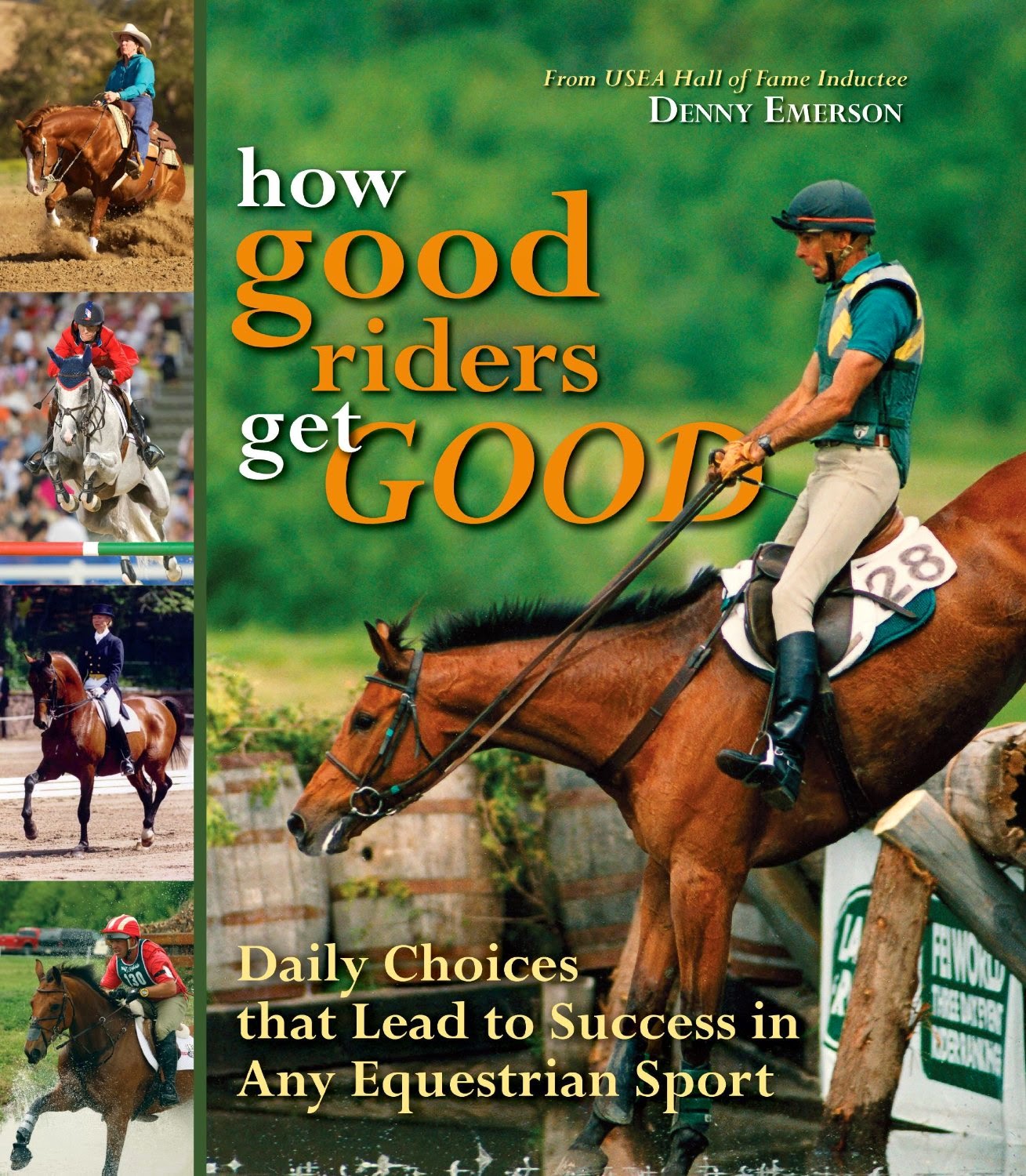
  • How Good Riders Get Good by Denny Emerson
  • The United States Pony Club Manuals by Susan E. Harris
You can get more information on these books from my December 9, 2014 blog, "Five Books IEA Riders Should be Reading"

Just like with the blog posts, keep notes in your journal of the things you learn and share them with your trainer.

7.  ...Attend a clinic with an upper level professional. If you're able to ride in the clinic, that's great, but if you can't ride, go anyway and audit or volunteer to work. Watching can sometimes be better than riding because you can focus on the instructor and all of the riders rather than worrying solely about yourself and your horse. Also, if you volunteer to go as someone's groom, you may be able to audit for free. And while you're there, offer to be jump crew, that way you can get inside the arena near the instructor.

8. ...Watch an upper level professional class at a rated show, such as a hunter derby or grand prix jumper class. Watch the class as if you were the judge and critique the riders. See what they are doing that helps them get the results they want. You may be surprised at how much you can learn by watching top level riders competing on top level horses.

9. ...Watch some top professionals ride in green horse classes at a rated show, such as baby green or pre-green hunters or training level jumpers. As I said previously, you can learn a lot by watching top level riders on top level horses, but you can learn a TON by watching top level riders on green horses. Try to see what they do to help their green horses get around the course successfully. How are they explaining the course to the horse as they go around? How are they building their mount's confidence? Watch the riders create a positive experience for their young green horses to build a solid foundation for more advanced work later on.

10. ...Stay positive. No matter what your riding goals, it is most important to stay positive and believe in yourself. Don't underestimate the power of positive thinking and don't let minor set-backs get you down. If you believe you can do something and work hard, you can achieve it.

Whatever your riding goals for 2015, best of luck and happy riding!


Amanda Garner is an Interscholastic Equestrian Association (IEA), Intercollegiate Horse Show Association (IHSA), and Georgia Hunter Jumper Association (GHJA) steward, schooling show judge, head coach of the University of North Georgia IHSA Equestrian Team, and owner of Epiphany Farm, LLC in Dahlonega, Georgia. She is also a member of the IEA Board of Directors and the author of "A Parent's Guide to the Interscholastic Equestrian Association."

If you enjoyed this blog post, please feel free to like and share on Facebook.
Thanks!  --Amanda

Tuesday, December 16, 2014

Guest Blogger Jadie Jones: The IEA Helps Coaches' Dreams Come True Too

From Amanda:  For those of you who may not know, I had surgery last Tuesday and have been spending the last week recuperating.  My very dear friend and fellow author/blogger Jadie Jones graciously agreed to take the helm of my blog this week.  So,without further adieu:

From Guest Blogger Jadie Jones:  The IEA Helps Coaches' Dreams Come True Too

I became involved in the IEA by accident. I was driving a new way home and saw a sign for a boarding facility. I called them to see if they had anything to lease. They asked about my background and riding experience. Instead of offering me a lease on a horse, they offered me a job. I started teaching there as an IEA coach three days later.

At home, I was mom to a one year old girl by day and an aspiring writer by night. I kept the writing aspect of my life mostly to myself. When people find out someone writes, the first question they often ask is what you’ve published, and I hadn’t published anything yet. Two months after I started coaching, the email landed in my inbox: a publishing house wanted my book. I taught in the afternoons and then toiled at my laptop into pre-dawn hours, racing through a series of editing deadlines while trying to juggle the rest of my life. The day we hosted our IEA show, I received the next big email, which revealed the cover for my book, the title: Moonlit, and a release date: April 14th, 2013.


My managing editor told me to find horse-industry professionals willing to read and review pre-release copies of Moonlit. Since I chose to use a pen name, I would need to contact them in person to eliminate confusion. I was intimidated to say the least. I reached out to Amanda Garner, who had stewarded several of the shows I’d been to that year. She seemed friendly, and I figured if she turned me down, she’d probably smile while she did it. I walked up to her at a horse show, my shaking hands stuffed inside my pockets, and introduced myself. Then I asked her if she liked to read. She lit up at the question, and we had a ten-minute conversation about our favorite books. At a pause in the conversation, I took a breath and a chance, and told her about Moonlit. She immediately agreed to review it, and she had a surprise for me: she liked to write, too. Amanda then pointed me in the direction of another IEA coach, Simon Towns, an avid reader and encourager of the arts, and the snowball of support began its roll. Roxanne Lawrence, founder and director of the IEA, invited me to come to the IEA hunt-seat championship in New York, which I agreed to as fast as I could. 


I saw the trip to New York as a finish line – some kind of culmination, when in actuality, it was a launch pad. Within three days, forty copies of Moonlit were given away as prizes, and I was interviewed for IEA’s Take the Reins magazine, which served to spread my first book all over the country. Robin Alden, youth manager of the AQHA, bought a copy of Moonlit and invited me to appear in the college showcase at the AQHYA “Built Ford Tough” world championships in Oklahoma City that August. Before I left for home, I purchased my plane ticket to Oklahoma. I also sold out of Moonlit. 


The best aspect about being involved in the IEA is this: you are surrounded by doers, movers, shakers, entrepreneurs, hard-working, I-dare-you-to-tell-me-no type people who change the minds of twelve-hundred pound animals on a daily basis. Equestrians are tough, stubborn, fierce, patient, compassionate, decisive, persistent, and supportive. We learn how to decide when it’s time to use muscle versus when it’s best to finesse. We cultivate a sense of humor for landing in the dirt instead of on the other side of the jump. And we dust ourselves off and keep going. These skills and this network help create habits and traits that serve its members well no matter what you decide to do with your life, no matter what dream tugs you into each new day.


About Jadie Jones
Georgia native Jadie Jones first began working for a horse farm at twelve years old, her love of horses matched only by her love of books. She went on to acquire a B.A. in equine business management, and worked for competitive horse farms along the east coast. The need to write followed wherever she went.


She lives with her family in the foothills of north Georgia. When she's not working on the next installment of the Moonlit series, she is either in the saddle or exploring the great outdoors with her daughters.

Jones is the author of the Moolit trilogy.  Books one and two, Moonlit and Windswept are currently available.  Book three, Wildwood, is set for release in 2015.


Enjoy Jadie Jones' post?  You can find more of her work on her website www.JadieJones.comlike her facebook page www.facebook.com/jadiejones1or follow her blog www.jadiejones.blogspot.com


Tuesday, December 9, 2014

Five Books IEA Riders Should be Reading

No matter how much time you're able to spend in the saddle, there is always more to learn. All equestrians can benefit from supplementing their lesson instruction with books written by successful riders and trainers.

So, just in time for the holidays, here is my list of five books IEA riders should be reading.

1.  Hunter Seat Equitation by George H. Morris


Could any equestrian book collection not include this definitive volume by the master horseman himself? In this timeless classic, Mr. Morris describes rider position and aides on the flat and over fences, lateral and longitudinal flexion in the horse, proper horse and rider turnout, and the fundamentals of horse showing, all with the frankness and attention to detail that you would expect. A must-read for every aspiring equestrian.

Once you've read the book, I encourage you to sign up for one of his clinics. I guarantee you will come away from the experience a stronger, and more humble, equestrian.


2.  Centered Riding by Sally Swift


Ms. Swift's book teaches riders how to work in harmony with their horses using yoga-like techniques such as breathing, balance, and body awareness. It is also full of illustrations and metaphors that can help visual learners grasp abstract concepts. Have you ever thought of yourself as an ice cream cone slowly melting down around your horse, or of your horse as a train travelling down a track? I personally use many of her methods in my own teaching and feel that her system of working through "feel" rather than simply through "mechanics" helps create happy horses and riders.


3.  How Good Riders Get Good by Denny Emerson


The purpose of Mr. Emerson's book isn't to teach you how to ride.  You won't find anything in there about "inside leg to outside rein" or "finding the perfect rhythm to a fence." Instead, it's a sports psychology book designed to help young riders develop their own path towards success based on their own personal circumstances.

Have you ever heard someone say, "I can't be an upper level rider because I can't afford a good-enough horse?" Emerson dismisses that kind of negative thinking with chapter titles such as, Wannabes versus Gonnabes, Dealing with the Cards you Hold, and Nine Character Traits for a Successful Rider. Throughout the book he also profiles dozens of famous riders, many of whom made it to the top though years of hard work, dedication, and sacrifice despite being born into families of modest means. This is a great book for aspiring professionals who want to learn the non-horse related skills necessary to make it in this business.

I also encourage IEA riders to visit Mr. Emerson's facebook page, Tamarack Hill Farm, where he regularly shares knowledge he has gained through his 60+ years of experience. I learn something from every post he makes.


4.  The United States Pony Club Manuals of Horsemanship by Susan E. Harris

I cheated a little bit here, because this is actually a set of three books:


Have you ever followed the IEA facebook trivia contests and wondered where many of those questions come from? In addition to being required reading for students involved in United States Pony Club (USPC), these manuals are also the basis for many written horsemanship tests, such as the horsemanship test offered each year at IEA National Finals.

The first volume covers the basics of riding, nutrition, grooming, hoof care, tack, and horse conformation.

The second volume builds on the information presented in the first. Topics include riding on the flat and over fences, horse care and management, conditioning, health care, wrapping and bandaging, and ground work.

The third and final volume is intended for those pony clubbers who wish to ride at an advanced level, manage a farm, and train young horses and/or teach riding as an equine professional.


5.  A Parent's Guide to the Interscholastic Equestrian Association by Amanda Garner


Shameless plug...In no way am I suggesting that I can hold a candle to the great horsemen/women listed above, but I do believe every IEA rider can benefit from learning more about the rules, regulations, and general structure of the IEA, as described in my book.

In Conclusion
So this is my list, I'd love to hear from my blog readers, what's on your horsey reading list?  Click back over to my facebook page and leave a comment.

Amanda Garner is an Interscholastic Equestrian Association (IEA), Intercollegiate Horse Show Association (IHSA), and Georgia Hunter Jumper Association (GHJA) steward, schooling show judge, head coach of the University of North Georgia IHSA Equestrian Team, and owner of Epiphany Farm, LLC in Dahlonega, Georgia. She is also a member of the IEA Board of Directors and the author of "A Parent's Guide to the Interscholastic Equestrian Association."

If you enjoyed this blog post, please feel free to like and share on Facebook.
Thanks!  --Amanda